 by Javier Marias
translated by Margaret Jull Costa
Javier Marias uses many, many, many words in this novel (the first in a trilogy) to say something rather vague (for the time being) about the power of speaking, thinking, or imagining, or not speaking, thinking, or imagining, or being silenced, told what to think, or what to imagine. A great deal of the tension in this sort-of spy novel comes from the constant reminder that doing any or all of the above has huge consequences, often dangerous or damaging to yourself, or others, or the entire world.
Jacques Deza is working a boring job for the BBC in England, set adrift after the failure of his marriage, having left his family to carry on without him in Spain. His elderly friend Sir Peter Wheeler arranges for him to meet the mysterious Mr. Tupra at a party, which leads to a new job for what we are left to guess is some branch of the British secret service. This party, Deza’s late night semi-frantic browse through Wheeler’s library, and the following day spent in conversation with Wheeler make up the bulk of the nearly 400 page book. The rest of it is a mix of scattered details from Deza’s first few months as a kind of interpreter of persons, and a few episodes from his personal life. Deza’s narration meanders back and forth and around and about, jumping ahead and then backtracking, picking up a thread dropped 100 pages before and carrying it for only a few paragraphs before abandoning it for another.
Somehow it all works – both the tangled story line and the many, many words. Deza is obsessed with words – not only are sections of the plot heavily dependent upon things said or not said, but he also (or I suppose Marias also) spends a great deal of time talking about specific words; words that appear in both Spanish and English, words that are untranslatable or have no equivalent in one or the other language. Both he and Wheeler converse freely in both languages, switching back and forth as their conversation dictates or the mood strikes them. Marias is careful to point out when this happens, often debating over what other words could have been used or listing them off. I found this both interesting and puzzling, and I’m really curious about how those parts go down in the original Spanish. Even when Marias (or Deza) was just going along with the flow of his narrative, he would take the time to describe things from several different angles, using different combinations of words to paint a more complete (or more confusing) picture. Lots and lots of words! But I liked them all.
Indeed, books like these grip me. The manipulation of the language is fascinating, the long sentences, the paragraphs overflowing with images and ideas. Comparisons to Proust were inevitable for me while reading this, especially since I was luxuriating in Finding Time Again only a few weeks ago. I love the wordiness. As I did with Proust though, I am wondering where Marias is going with all this. In Fever and Spear he touches upon recollections of events from the Spanish Civil War, the London Blitz, the current post-9/11 state of world affairs, and sets Deza up in the uncomfortable position of a people reader for an organization whose purpose is cloudy. Scattered throughout the book are a few tantalizing bits of plot (the blood in the stairs, the helicopter that lingers overhead, the mysterious woman who follows Deza home in the rain) which are very “spy-novel”, but WHAT is going to HAPPEN? I have to assume that Marias wouldn’t have had Wheeler go on at such length about the “Loose Lips Sink Ships” campaign in England during WWII, the campaign to silence the public, if it wasn’t going to play a later role – but I could be wrong.
Proust could maintain his wordiness over the course of seven volumes, but it remains to be seen if Marias can pull off a similar feat. I read this first volume as part of Richard’s Your Face Tomorrow readalong and I only committed to the trying out Fever and Spear. I’ll definitely be forging on though. I am on pins and needles here, which is saying quite a lot considering that almost nothing has happened so far! If anyone cares to join in for volume 2, Dance and Dream, we will be discussing it towards the end of July. (Or if you’re like me, a week later or so!)
Here’s a bit from early in the book that is a good example of Marias’ style and ideas:
‘All the words we have seen uttered in the cinema I myself have said or have had said to me or have heard others say throughout my whole existence, that is, in real life, which bears a closer relation to films and literature than is normally recognized and believed. It isn’t, as people say, that the former imitates the latter or the latter the former, but that our infinite imaginings belong to life too and help make it broader and more complex, make it murkier and, at the same time, more acceptable, although not more explicable (or only very rarely). A very thin line separates facts from imaginings, even desires from their fulfillment, and the fictitious from what actually happened, because imaginings are already facts, and desires are their own fulfillment, and the fictitious does happen, although not in the eyes of common sense and of the law, which, for example, makes a vast distinction between the intention and the crime, or between the commission of a crime and its attempt. But consciousness knows nothing of the law, and common sense neither interests nor concerns it, each consciousness has its own sense, and that very thin line is, in my experience, often blurred and, once it has disappeared, separates nothing, which is why I have learned to fear anything that passes through the mind and even what the mind does not as yet know, because I have noticed that, in almost every case, everything was already there, somewhere, before it even reached or penetrated the mind. I have therefore learned to fear not only what is thought, the idea, but also what precedes it and comes before. For I am myself my own fever and pain.‘ p. 16-17 New Directions edition
Wow. And also, Yikes. That stuff goes straight to my head, leaving me dizzy and delighted and disturbed.
Until the next volume finds me via inter-library loan (or perhaps from New Directions – I’m considering purchasing the trilogy) I think I will peruse a few volumes of Tintin (which Deza mentions his children reading several times, and also an old favorite of mine) or perhaps finally get round to trying out an Ian Flemming novel (also referenced, From Russia With Love specifically). But first, the sure to be thought-provoking posts of my fellow readalongers!
 by Junot Diaz


 I assume that not many people grab an Ubu play and head to the beach. I have done it once, and I have no aspirations for a repeat performance. Imagine: There I am, stretched out on a blanket spread over comfy cobblestones, under a beaming sun, with the frigid Atlantic creeping ever closer to my naked toes, nose buried in the “Pschitt” of Ubu Rex. Without warning a panting and ecstatic golden retriever appears at my ear, scaring me into a crabish scuttle to the left accompanied by a shout of “By my green candle!!” (or yes, maybe something closer to Pa Ubu’s historic first utterance). Since my Conscience is NOT shoved head first down a latrine (between two stone footrests) I easily avoided any hard feelings toward the dog or his apologetic owners, and soon after I was waving farewell to Ma and Pa Ubu as they sailed further and further away from France headed for a country extraordinary enough to be worthy of their presence.
 Finding myself here at the tail end of Ubu Week, my best bet is to direct any interested parties to

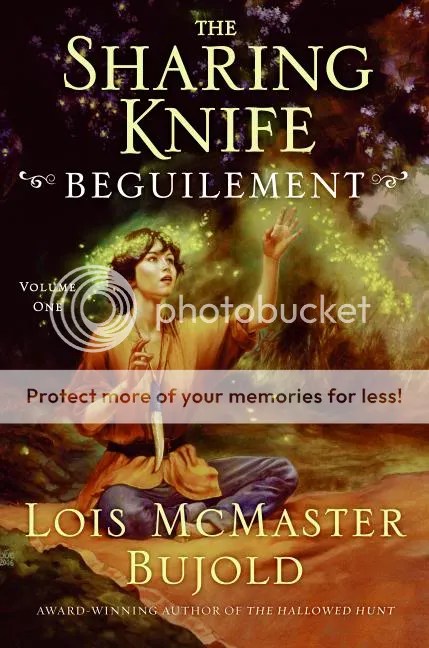 One of my favorite books is The Curse of Chalion by Lois McMaster Bujold. I have read it several times (as well as the several sequels) and each time I am newly blown away by the world of Chalion, where medieval life coincides with gods and magic in a way that seems wonderful and terrifying and plausible. The characters are brilliant and the plot sweeps me up every time. However the last time I read it was at least 5 years ago, and my reading tastes have developed somewhat since then so I’m a but nervous about revisiting this book and finding it…changed. I opted to revisit Bujold, but via a new (to me) book – I ventured into the world of The Sharing Knife series (which I just discovered right now is 4 books, and not 2…huh…interesting). I read
  I’ve been on a Maggie Stiefvater kick this year, adding
  I returned to Discworld in May with absolute pleasure. The last thing I read by Terry Pratchett was
  And my final book read with the Once Upon a Time Challenge V in mind was









 what we have here is a failure to communicate