Posted by: Sally Ingraham | August 27, 2009

Mrs.ย Dalloway

Mrs. Dallowayby Virginia Woolf

I’ve been a little nervous about writing something about this book since I don’t have any special insights into it, or opinions. But I have to talk about it, because I have such a deep, wonderful feeling of delight. I enjoyed this book on so many levels. The writing is incredible, and distinctively different. From the description on the back I was led to believe that the book followed the events in a day of Clarissa Dalloway’s life, which it does. However the other people she encounters, and the way the threads of the story flow from them to still other people, made the short book seem like a huge experience. I was caught up in it in a way I haven’t encountered before. I wanted to read it all in one sitting, but at the same time wanted it to last as long as possible. I thought about it frequently when I wasn’t reading it. I was intrigued by the headlong rush of the storytelling, which was at the same time a leisurely meander through a warm June day in London.

I think that is what fascinated me most about the book – the steady passing of physical time, and the internal, often hectic, passage of time as shown by the variety of characters. The book offered me a visual (oddly enough) of the incredible internal dialogue that accompanies every aspect of our lives, and is often more real than the physical world around us. The events in a day, and the internal events ought to provide a constant balance, but this book also clearly showed what can happen when one or the other starts to dominate. The book was a brilliant study of that, as well as fulfilling on an emotional and even entertaining level.

I finished it almost a week and a half ago, and I’m still thinking about it frequently. I feel an intense desire to read it again, this time with more attention to detail and with less distractions from my real life interupting me. My original feeling that the book wanted to be read in a quiet, sunny room is even stronger now, and that is definitely where I want to read it for the second time – someone please find me the room and the time! ๐Ÿ™‚

I would love to hear anyone else’s thoughts about the book – especially your first time reading it. I just don’t want to let it go yet. ๐Ÿ™‚

Posted by: Sally Ingraham | August 26, 2009

BBAW Nomination – THANKS!

It’s really (seriously) time that I get Internet access at my home again… The computer at the store died last week, and although it was miraculously brought back to life, it made my life a little more difficult for awhile! I have potential reviews piling up, and have had to neglect one of my favorite activities – reading other people’s blogs!

Hopefully things have returned to normal now, and when I did get back on the Internet I discovered something wonderful! My big piece of news is that I received a nomination for Best General Review Blog from some incredible person involved in the Book Blogger Appreciation Week (Sept. 14th-18th)!! I’m kind of new to book blogging so I had to go find out what BBAW was, and now having learned some more about it I am totally blown away by the generosity and support that the book blogging community is bursting with. A huge THANK YOU to whoever nominated me – that in itself is awesome. ๐Ÿ™‚

Now I’m off to catch up on some reading – book blog reading, that is!

Posted by: Sally Ingraham | August 14, 2009

Into the Beautiful North (and a Giveaway!)

Into the Beautiful Northby Luis Alberto Urrea

Several months ago I won a set of 5 Latino books, given away by Hachette Book Group, through the lovely Claire at Kiss A Cloud. I have won very few things throughout my life, so I was completely blown over with delight when I found out, and equally excited when the books arrived a couple weeks ago.

All recent publications, the books are:
B as in Beauty by Alberto Ferreras
Into the Beautiful North by Luis Alberto Urrea
Hungry Woman in Paris by Josefina Lopez
The Disappearance of Irene Dos Santos by Margaret Mascarenhas
Houston, We Have a Problema by Gwendolyn Zepeda

I read Into the Beautiful North in three days, which was so refreshing after slogging through the majority of my reading choices in July.

The book follows the escapades of 19 year old Nayeli, who lives in the quietly dying Mexican town of Tres Camarones. All of the men have gone north to find jobs, leaving the town vulnerable to a group of drug dealers with big plans to take it over. After watching The Magnificent Seven at the town’s decrepit theater, Nayeli collects a group of friends and sets off on a quest to cross the border into the mythical USA and bring back seven Mexican warriors to defend Tres Camarones and revive the town. Of course things don’t go quite as smoothly as she hoped and there are lots of things to discover about America, Mexico, and herself on the journey.

Sounds lovely, right? And it is, in an almost fairytale-like way. The book overflows with quirky characters, and is quite funny. It has a very serious edge to it though, providing an insiders look at border crossing, the harsh existence the destitute of Tijuana endure, and the uneasy relationship between the Americans (both legal and illegal) and the ‘wetbacks’ (recent crossers) whom they encounter. This reality met with a certain amount of disbelief for me in this book – I didn’t find the overall story ‘believable’ in the sense that ‘this could really happen’. I didn’t find myself caring that much though – the story is entertaining and the writing is really lovely. It’s a happy – even joyful book – and while I was reading it I felt luminous and warm and full of laughter.

I will definitely be seeking out some of Urrea’s other books, and if anyone is interested in reading some other thoughts on this one check out Bethany’s review of it. She also got to meet the author and wrote a great post about that.

And finally, I have books to give away! Through an epic mix-up at Hachette, I received 5 complete sets of those books. I plan to pass them around to my friends and co-workers, but I would also like to split a set among any of you who is interested – leave a comment about the book you would like, first come first serve, one book each. ๐Ÿ™‚

iphigeniaby Teresa de la Parra

The heroine of this book, Maria Eugenia Alonso, ‘…is a half-educated young woman, confused by personal vanity and romantic fantasies, often floundering in her efforts to express a critical outlook on society and personal relations.’ So says Naomi Lindstrom in her introduction to the book. I was grateful for her introduction, as it helped me to keep clear in my mind the intent of the author who brought the flighty, excitable Maria Eugenia to life.

I both liked and disliked this book, and I both identified strongly with and at the same time could not comprehend Maria Eugenia. Written through a very long letter and then a series of diary entries, the book follows a few years of Maria’s life – from when her father dies and she leaves France to return to her family home in Caracas, Venezuela as an 18 year old, up until her marriage to Cesar Leal.

I readily identified with Maria’s use of the written word to help puzzle out the world around her. She is intelligent and independent-minded, and her glimpse of freedom before she was thrust back into the sheltered environment of her society sparked off a good deal of thoughts and insights on her part. I enjoyed many of these. On the other hand her focus on material pleasures and comforts irked me. One moment she would be dishing out a lovely strong opinion and the next she would be melodramatizing her plight. She frustrated me in that she tried to fight against the strict moral and social codes enforced by everyone around her, but she didn’t try in the right way. For instance, she secretly read books that her Grandmother didn’t approve of, but she did it only for pleasure and out of stubbornness. It didn’t occur to her to apply herself a little more and actually study.

The book was scandalous when it first came out in the early 1920s because it painted such a clear portrait of a passionate young woman completely trapped in a patriarchal society, who because she lacked the money to establish herself, was forced to remain there, ‘sacrificed’ like Iphigenia of the Greek myth.

The ending of the book is disappointing but not surprising. I was expecting it, and since I didn’t feel very invested in Maria’s fate I found myself bored by the agony of her choice between the married man she adores and the wealthy fiance whom she hates. I didn’t find myself despising Maria for her choice, however, so in that Teresa de la Parra was successful, in showing how it was the society that beat down so efficiently a bright and beautiful girl. The book is full of energy but is ultimately deflating.

After finishing it I did find myself feeling profoundly grateful that I don’t live in Maria’s world, and that even though I am so similar to her (half-educated, confused by personal vanity and romantic fantasies, often floundering, poorish) I can forge my own way in the world and pick my adventures and pursuits. And I don’t have an overbearing grandmother snatching books like this one out of my hands!

I definitely want to find out more about the author, as she was everything that Maria wanted to be – well read, socially prominent, elegant, respected – a free woman. She succeeded in the society where Maria failed, and it was this that prompted her to write Iphigenia so that in some way she could encourage other women to do the same. After being kind of bummed out by Maria Eugenia Alonso, I am ready to be inspired by Teresa de la Parra!

(This was my 5th book for the OT Challenge, although I didn’t manage to finish it until August… On to my 6th book!)

Posted by: Sally Ingraham | July 29, 2009

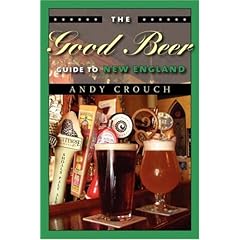
The Good Beer Guide to New England

good beerThe only book that I am really enjoying reading right now is Andy Crouch’s The Good Beer Guide to New England which a friend of mine gave me last year for my birthday. I hadn’t touched it until last week, when I decided to flip through it and see how many of the breweries/brewpubs he mentioned I had been to. I got sucked into the book itself pretty quickly, although my perusal is still pretty non-linear.

Andy Crouch is a very enthusiastic and knowledgeable guide, and his obvious love for his subject as well as his ability to tell a good story both make for entertaining as well as informative reading. Split into sections by state, each chapter contains detailed profiles of the breweries, as well as some of the history of brewing in that state. I’m getting a big kick out of reading his descriptions of his visits to many of the same brewpubs I have visited over the past two years, as well as picking up many tips as to where to track down some of the more obscure New England brews made by some of the smallest breweries in the country. From backyard operations to the Anheuser-Busch plant in MA, Crouch covers it all.

Of course since it was published in 2006 it is already slightly out of date. The rate at which brewing operations open and close has stabilized a bit in this area, but there are enough differences already that I hope Crouch puts out a second edition sometime soon!

As for me, following the example set by Josh at Brews and Books I intend to more fully embrace a passion that has continued to grow in my life – craft beer. Which means that my readers are going to have to tolerate not only awkwardly constructed book and film reviews, as well as my obsession with bridges, but occasionally listen to me rave about Longtrail’s Blackberry Wheat (I have NEVER met a wheat I liked until this one) or squeal about the new Penobscot Bay Brewery, which is already bottling a Scottish Ale that I intend to sample very soon!!

Here’s a list Josh has compiled that links books to beer in a fabulous way – check it out!

Posted by: Sally Ingraham | July 23, 2009

Reading Slump, The Tin Drum, and Potter

I feel like my reading has slowed way down this month. It’s busy enough at my jobs now that I don’t get to read at them very often, and I’ve been playing outside on my weekends, because the past couple have actually been beautiful. I have been paddling and bicycling and hanging out with friends. My boyfriend and I went the Vermont Brewers Festival this past weekend, in Burlington, which was a splendid adventure.

the guermantes wayBut my reading is suffering. I started The Guermantes Way by Marcel Proust on July 10th, to celebrate his birthday and end my month-long break from reading Proust. As of today I’ve only made it 20 pages in… However this works out all right because it means I can join Frances and Claire’s shared reading project. The deadline for finishing The Guermantes Way is November 6th. I should be able to make that!

Other books that I haven’t made much progress with are The Pickup by Nadine Gordimer, and my current OT Challenge read, Iphigenia (The diary of a young lady who wrote because she was bored) by Teresa de la Parra. About halfway through The Pickup I just lost interest, so I put into practice my new-found rebellion against the “you must finish the book” law and returned it to the library.

I’ll make more of an effort with Iphigenia, as I do like it fairly well. The main character is a little too self-absorbed and materialistic, but I identify with her use of writing to sort out what she thinks about the world as an inexperienced 18 year old. More about the book when I finish it…

The Tin DrumI watched The Tin Drum the other day. Directed by Volker Schlondorff (who made Swann in Love which I liked a lot) it won an Academy Award in 1979 for Best Foreign Film. What a weird movie!! It is about a German boy who at the age of 3, disgusted by the unhappy examples of grown up life that surrounds him, decides to never get any bigger. From that moment on he remains in appearance a 3 year old, and he goes through life pounding on a tin drum, and when life gets really unbearable, emitting a literally glass shattering scream. Germany moves toward Nazism and WW2 descends upon little Oskar, who continues to beat his drum. What was interesting to me was the fact that although his body didn’t grow, Oskar couldn’t stop his mental development or fend off all of life’s troubles by simply remaining small.

Books and movies and adventures, as always, and to top it off I am now dreaming about Harry Potter… We got the 6th film instalment for it’s opening run at Reel Pizza Cinerama. Tonight is the last night we will be playing it. We have sold out every single show – two per night – and even though I was fortunate enough to have several evenings off during that time, it has still been an intense working environment. I haven’t actually seen much of the film yet, but what I have seen looks pretty good – and it is now invading my dreams. Oh well, there are worse places to dream about than Hogwarts I guess!

Best wishes to everyone else who is striving to balance life and work and reading! ๐Ÿ™‚

Posted by: Sally Ingraham | July 15, 2009

Little,ย Big

Little Bigby John Crowley

I’ve been on the brink of writing something about this book for the past week. I keep sitting down and staring at the computer screen instead. I can’t seem to frame my thoughts at all.

At over 500 pages, the book is an epic tale which, in it’s simplest terms, traces the story of Smoky Barnable and his life after he marries Daily Alice Drinkwater. It’s about Edgewood, a mysterious house which may, or may not, be a door into another world. It’s a family saga, a secret history of an unspecified area of New England. There are faeries, sort of. There is the TALE, the hinted at fate that the entire Drinkwater clan has been moving toward since Violet Drinkwater left England a hundred years ago.

It’s really beautifully written, and moves along at a steady, dreamy pace. The characters – a whole family tree worth of them – vary in how solid they appear, which is kind of appropriate. I felt, as I read, that I was seeing the events of the story through a pool of water that rippled just enough to never provide a clear picture. It was a fascinating way to experience a novel, although I’m glad most of the things I read are not so…vague. I felt as though I was piecing together a stained glass window and if I could just get it together it would be brilliant. I liked the book a lot, but I finished it with an uneasy sense of having not really gotten it.

From some interviews I’ve read, I think that John Crowley would not be surprised at my reaction. He intentionally wrote it “through a glass darkly” I think. It’s bugging me though. I have an obsessive desire to read it again and soon. This time I’ll take notes! (I once spent a summer reading The Lord of the Rings, taking notes, cross referencing, investigating other sources… I was very serious about getting it, whatever “it” was!) I’ll try to hold off for awhile – too many other books to read. *sigh*

Has anyone else read Little, Big? What did you think?

Posted by: Sally Ingraham | July 8, 2009

Theย Shipyard

the shipyardby Juan Carlos Onetti

This book finally came in through ILL last Friday. I read the entire thing on Monday, taking breaks to go kayaking and walking and listen to a couple of newly purchased albums. It really was the perfect day off, especially because the sun came out and I got to spend almost the whole day outside. I was beside myself with pleasure.

The tone of The Shipyard is very much the opposite of how I felt that day, but somehow the contrast only increased my own delight in being alive. The book is slow, sad, dreary – not so much depressing as deflated. The narration trudges along behind a man named Larson, who has shuffling back to the region of Santa Maria after five years in exile. He has a sort of half-hearted thought of making a comeback, and with this in mind he takes a job as the General Manager of a failing shipyard. Only two other men work there, routinely going through the motions while the owner is off trying to get the bankruptcy order lifted.

In trying to think about what happened in the book, I get lost. Larson is a fairly full-bodied character, but everyone else – the men he works with, his love interest, Angelica Ines, and the other women he encounters – all seem shadowy. The book seems to be less about the events that occur and more about the mood. There is an odd kind of urgency in the mood of the book – everyone and everything in it seems to be poised on the brink of something, but have been poised so long that the weeds have started to grow and the waters have grown stagnant. If only, if only something could be done, something to snap the stupor, everyone, everything, is ready for action. The book is one giant held breath, waiting to be expelled.

I can’t decide if I liked The Shipyard or not. I was fascinated by it, certainly. I was especially struck by Larson’s awareness of the dualness of his person – his internal thoughts and feelings, and how his face and body reacted to situations. He was constantly putting on a mask, slipping into the costume of a man who was full of faith and sincerity, almost believing his own act sometimes. How often do we all do that?

Onetti’s style is mesmerizing, and while I can say I didn’t enjoy the book exactly (in the sense that I enjoyed the sunny day,) I did find it thought provoking. A couple of the conclusions that Larson comes to are definitely interesting.

“…life holds no surprises; at least not for real men. … As for the meaning of life, don’t imagine I’m talking nonsense. I know a thing or two. We do things, but can’t possibly do more than we do. Or to put it another way, we don’t always choose.”

He suddenly suspected what everyone comes to understand sooner or later, that he was the only person alive in a world peopled by phantoms, that communication was impossible and not even desirable, that compassion was worth more than hate, that a tolerant indifference, an attention divided between respect and sensuality, was all that could be asked for or given.”

It was hard for me to agree with these sentiments on such a glorious day, and even now (that the sun has gone away again…) I would still beg to differ. There have been times in my life when I have felt that I was trapped and that life had gotten out of my control, but I’ve never felt that I wasn’t the one that had done the choosing. I do recognize the helplessness (even just the exhaustion) that Larson felt, and so perhaps I can move on from this book with a greater sense of thankfulness – that the sun does still come out (once a week or so…) and that I’ve never yet encountered anything as dreary as the shipyard!

Even so, I’m not sorry I fell under it’s spell for a day. ๐Ÿ™‚

Posted by: Sally Ingraham | July 1, 2009

The Old English Peep Show and The Lathe of Heaven

Yesterday afternoon I saw sun again for the first time since last Thursday. It had been overcast, foggy, and rainy for days before those three hours last Thursday, and the weather returned to that pattern for the following days until yesterday afternoon arrived. I had the evening off so after leaving the Country Store I went home, and because it was actually too hot to go hiking, I spent the rest of the daylight napping and reading Little, Big by John Crowley in the sun.

We got 10 inches of rain in June and had many more dark days than sunny. Normally this type of weather would cause me to lose my mind. However I managed pretty well last month (hurray, it’s now JULY!). I simply decided to take on a “Seattle” mindset – by which, most unfairly perhaps, I mean this: instead of hoping for sun I just assumed there wouldn’t be any and got on with my life, drank LOTS of coffee, and lost all guilt over staying inside reading and watching movies all day.

Peep ShowAside from all the things I’ve already posted about here, I also finally tracked down one of Peter Dickinson’s earlier novels – The Old English Peep Show – a mystery set at an old country estate where poor Inspector Pibble is up against aging Generals/War Heros, lions, and the dark force behind profitable enterprise. My father has always told me to look for Dickinson’s old mysteries, but until unearthing this one in the basement collection at Jesup, I was missing out! A fast, fun read with well drawn characters, and lots of odd quirks.

Lathe bookThe other book I found in the treasure trove of the Jesup basement was Ursula K. Le Guin’s The Lathe of Heaven. I wanted to read it so that I could watch the movie that is based on it. I had found out from her web site that this movie was just about the only movie based on one of her books that she liked. The book proved to be fascinating. It is set a bit in the future, and focuses on George Orr, who has a slight problem with dreaming. His dreams change reality, or so he claims and that is why he overdosed on drugs – he was taking them to prevent himself from dreaming. He is sent to a psychiatrist who specializes in dreams, and quickly proves that he is not kidding around, nor is he crazy. Dr. Haber realizes the potential for good that Georges’ dreams provide, and he in turn proves how very wrong things can go when someone tries to change the world and control their own destiny. The book is a whirlwind, as each time George dreams both he and the reader have to come to terms with the newest version of reality. Beautifully written as always with Le Guin’s work, this book blew my mind. ๐Ÿ™‚

LatheThe movie was really interesting too. It was extremely close to the book, and as such was very satisfying. It was made in 1980 and was PBS’s first direct-to-TV production. The budget was small and the scope of the film large, but for what they had to work with I think the result was excellent. My viewing enjoyment was somewhat hampered, however, by a terrible transfer to DVD. There was large degree of “ghosting” which was distracting. Apparently this is because PBS didn’t save a copy of the production after the rights to rebroadcast expired! It was too expensive to pay for all the rights they needed to continue broadcasting. The home video release was remastered from a video tape of the original broadcast, and I assume that’s where the DVD came from too.

Anyway, I’ll stop boring you with the details! I definitely recommend the book, and in spite of it all recommend the movie to anyone who wants to see Le Guin’s work accurately reproduced on screen.

totoroMy final fond memory from this past rainy June is waking up late on a Saturday and tumbling out of bed, only to curl up in a blanket and watch My Neighbor Totoro and laugh and cry and in general thoroughly enjoy that dreary, lovely morning.

Posted by: Sally Ingraham | June 30, 2009

OT: The Book of Embraces โ€“ Uruguay

The Book of Embracesby Eduardo Galeano

I was going to read The Shipyard by Juan Carlos Onetti as my Uruguay pick for the OT challenge, and June was the month for it. However I was thwarted by the ILL system here in Maine, which is undergoing some transitional thing that has caused major delays in state wide book traveling. As the month drew to a close I began to panic, and finally gave The Shipyard up as a temporary loss. Crossing my fingers I went to the library at COA (where I recently was initiated into the patron record!) and looked for something, from any South American country, that I could get through before June ended.

After nearly giving up, for the collection had an abundance of Mexican and Argentine writers but not a whole lot else, I emitted a little squeal when I scanned the back of The Book of Embraces and saw the words, “Uruguayan writer Galeano“.

A quick flip through the book proved it to be full of drawings and lots of empty space – thankfully a quick read! It proved to be a fascinating one as well. It is composed of short pieces of writing that provide a collage or a kaleidoscope view of the author’s life and the state of affairs in Latin America during the 60s-late 80s. Some pieces are historical, some are political, some are autobiographical, some are stories other people told him, and some are just small beautiful thoughts.

At the beginning of the book Galeano put this: “Recordar: To remember; from the Latin re-cordis, to pass back through the heart.”

As an older man Galeano is passing the events and experiences of his life back through his heart, and he is embracing all of it – joys and sorrows. My knowledge of events in Latin America over the past century is spotty at best, so it was eye-opening for me to read of revolutions and dictatorships and torture and exile happening in so many different countries. Galeano wrote about these terrible events just as gently, though, as he wrote about his wife’s dreams or told a tale that celebrated art. Yet while his writing was “gentle” there was also a force behind it that made almost every piece impact me.

There are a lot of things that made me sad in this book, but the fact that Galeano could reach this point in his life, look back, and then look forward and say he is not finished with living makes me glad.

I still have a long way to go. There are moons at which I have not yet howled and suns which have not yet set me alight. I still have not swum in all the seas of the world, of which they say there are seven, nor all the rivers of Paradise, of which they say there are four.
In Montevideo, a child explains:

“I never want to die, because I want to play forever.”‘

I am also glad that I have discovered Galeano and intend to read some of his other work – of course!

On one other note I was extremely satisfied as well, and this was to discover how close Galeano and Cedric Belfrage, his translator, were. I often wonder, when I read translated works, how faithful to the original they are – not just in words, but in tone. There can be no doubt about Belfrage’s translation. In a note at the beginning of the book Galeano wrote this about Belfrage, who died shortly after finishing The Book of Embraces:

I would recognize myself in each of his translations and he would feel betrayed and annoyed whenever I didn’t write something the way he would have.

That’s lovely. It makes me feel that I am not missing as much by being such an English only reader. However, I would very much like to someday read a non-English book in it’s original language. Learn Spanish (or Russian, or French) is still on my to-do list!

« Newer Posts - Older Posts »

Categories