As of 9:30 this morning, I now have internet access at my house! This means that instead of painting in the bathroom, or tearing down the wallpaper in the kitchen, or raking leaves, I will be spending the rest of the morning playing on my computer – and specifically catching up on my “movie mayhem” posts for the last two months. I really like making notes on the movies I watch, and now that I have easy internet access I hope to get this blog feature back under control, tidied away into weekly, or bi-weekly posts. For the moment though, here are some notes that are far from tidy:
Out of 26 movies I’ll spare you and mention only a few that were particularly interesting to me.
 It strikes me as odd that I have gone so long without seeing a single film by Jean-Pierre Jeunet. Shouts of appalled astonishment from friends or co-workers have often greeted this revelation, but it has not been particularly intentional. “On the to-do list, o’course” was usually my answer, and I meant it. Even so, I didn’t bother to seek his films out until one was tossed unceremoniously into my lap. Micmacs (France, 2009), Jeunet’s most recent offering came to a movie theater near me – the theater where I work. Unavoidable. So I watched Micmacs and liked it a lot. What’s not to like about a colorful band of misfits who concoct an outrageous plan to take down two major weapons manufacturers? Bizarre and wonderfully detailed sets, fantastic characters, and a plot that was clever and original, plus the right mix of action/adventure and a cute love story. Almost too perfect, nothing challenging there, but so enjoyable. I of course determined to watch more from Jeunet! Delicatessen (France, 1991) proved to be similarly imaginative – although a bit more warped and with a slightly darker brand of humor. In a weird post-apocalyptic world where food is scarce, a landlord/butcher occasionally puts the knives to his assistants and serves them up for his appreciative tenants. When his daughter falls in love with the most recent assistant, a charmingly goofy ex-clown, she seeks out the vegetarian troglodytes, a sub-society that live beneath the streets, for assistance with a rescue mission – which of course goes horribly awry. Again, astonishingly interesting set design and whacky characters make for a fantastic movie. In both films, actions over words and slapstick humor are used to great effect. While I watched both films purely for their entertainment value, I am aware that there are ideas just under the surface that beg to be explored. I said that there was nothing challenging about Micmacs, but I beg to differ with myself already, and I believe that a second viewing of these movies will give me something to think about. I think I’ll indulge in a “Jeunet week” sometime this winter!
 Still smarting from the appallingly bad Nine, and having been only somewhat mollified by watching Federico Fellini’s original film 8 1/2, I found Fellini’s Roma (Italy, 1972) quite interesting. I kind of had the idea that theoretically it is the movie that Guido, the director character from Nine started making at the end of the film…not sure where I got that idea from…and not that I care! Anyway, so I watched Fellini’s Roma and found it’s impressionistic depiction of Rome very intriguing. Partially an autobiographical memory of Fellini’s arrival in Rome during the Mussolini years, and partially present day (1970s) footage, the movie is essentially plotless. It’s various episodes (a visit to a brothel, a lengthy and bizarre ecclesiastical fashion show, an exploration of ancient roman rooms discovered while digging a subway tunnel, a huge traffic jam, a visit to a music hall, an outdoor meal with neighbors…) hang together in the sense that each portrays an aspect of daily life in the city. The pace is slow, but the movie roars with life. Fascinating stuff.
 In September the theater where I work hosted the second annual MIFF by-the-Sea film festival, an extension of the Maine International Film Festival which takes place in Waterville in July. Like last year, there was a collection of Maine-made films, international offerings, and documentaries. I got to see 5 films – two shorts, one from Kyrgyzstan, and one from Kazakhstan; a fascinating movie about a man and a gallery in Uzbekistan that collected Soviet-censured art, aptly called The Desert of Forbidden Art ; a Serbian made-for-TV doc about the Belgrades of the world, one of which is in Maine of course; and my favorite of the festival, Sita Sings the Blues (Nina Paley – USA – 2008). This was a gorgeously animated retelling of the Indian epic Ramayana. The several animation styles by themselves were interesting, and the three absolutely hilarious narrators – exquisite shadow-puppets – were fantastic. What made the movie particularly distinctive though was the fact that it was set to the 1920s songs of Annette Hanshaw. As the story progresses, Sita repeatedly breaks into song – and it is a bluesy, jazz piece sung by Annette Hanshaw which perfectly describes Sita’s current predicament! It’s brilliant and so funny. There are incredibly dramatic moments in the story too, and a fairly serious sub-plot that follows the story of the director’s dissolving marriage. It’s really a remarkable piece. I liked it so much that I got it through Netflix a few weeks later to watch again, and I’ve decided it needs to go in my permanent movie collection. 🙂
 What else…? Let’s see, Yojimbo (Akira Kurosama – Japan – 1961) was quite interesting. It’s the movie that inspired Sergio Leone’s A Fistful of Dollars. In Kurosama’s world, it is a wandering ronin who comes to a town that is being slit apart by the swords of two rival criminal gangs. Sanjuro, portrayed by the masterful Toshiro Mifune, plays the two gangs against each other for his own apparent profit, but of course he really has a heart of gold and ends up putting his life on the line for a couple and their son, and his friend the innkeeper. Almost blow by blow the same story as Leone’s film, and equally full of that “slow action” I took note of in A Fistful of Dollars. Kurosama came up with it first though, and I’m eager to watch his follow-up, Sanjuro. And heck, while I’m at it I guess I’ll have to watch Leone’s For a Few Dollars More…!
I guess I’ll let the rest of the movies from these two months slip through the cracks of my blog. There certainly were more good ones, and I’ll probably do a round up list at the end of the year because I LOVE lists, so that’s enough blathering for now. Hope you all are watching fun things, and please don’t hesitate to recommend movies to me. 🙂
 Ah Perec, you’re clever but you didn’t think of it first. Come to find out, in 1939 to little pomp and circumstance a fellow named Ernest Vincent Wright published a book called Gadsby, subtitled rather explicitly, A Novel of Over 50,000 Words Without Using the Letter “E”. Here’s
  I think it’s funny that Wright wrote his book to prove that it could be done, and in his postscript Perec writes that he wrote his book to prove the same thing to a companion who called his bluff – ‘I said I could do it, this companion said I could not’. Some people claim that Perec’s effort is more successful, more satisfying overall than Wright’s. What do I think, about Perec’s success at least?

 by Tobias Wolff
 Over the course of a year filled with the viewing of hundreds of movies, the horror genre takes a far back seat. The gore caused by chainsaw wielding madmen, viscous ghosts, exorcisms… Yeck. I just don’t usually want those images in my head. I can take the stuff in small doses, and in mild forms, and certain styles appeal to me. Hitchcock I like, atmospheric weirdness like The Shinning both pins me to my seat and thrills me. I never really know what will work for me – I just know that I’ll never feel the need to watch Turistas!
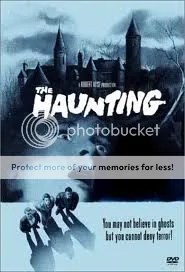 However, for the Peril on the Screen portion of R.I.P. V I decided to throw caution to the wind and watch…at least one scary movie. I ended up sort of watching three, although the 2009 version of Dorian Gray starring Ben Barnes and Colin Firth failed to either scare or thrill me, and Repo Men was just outright annoying. Which leaves me with my one scary movie – exactly the sort of mood based subconscious-screwing spook fest that really gets under my skin. It was the 1963 The Haunting, of course, which I had to watch as a follow-up to my reading of
  It turned out to be a startlingly fabulous book-to-screen transformation. Slight details in character names and motivations were changed for the script, but the mood of the book was perfectly captured, and the use of camera angles and tricks in set design and shot composition brought the haunted Hill House to life in a way that impressed me and totally freaked me out. Nothing truly scary happens in the movie, but the creeping of the characters through the house, the unexplained noises in the corridors, the half-glimpsed reflection in the mirror, and the build-up of the effect as seen in the reactions of poor Eleanor, is subtly frightening. My boyfriend tried to watch it with me, but it was too much for him! His nervous prowl of the house only added to my own tense state. The acting in it is excellent, with particularly good performances from Julie Harris and Claire Bloom as Eleanor and Theo. And Rosalie Crutchley as Mrs. Dudley, the strange housekeeper, was horribly perfect – of all the moments in the movie, the part that I can’t seem to forget is when she is telling Eleanor that she and her husband leave the house at dusk, so there will be no one to hear them scream, in the dark…in the night….ahhhh!! So creepy, so brilliant.
 On a random side note, when I was reading the book I felt like it was set in England. I might have missed a detail. In the movie the driving instructions that Eleanor receives clearly mention Boston and indicate that Hill House is in New England. That makes sense because Shirley Jackson was American, so the house should definitely be located in New England. In the movie though, all the filming of the house was done at Alderminster, Stratford-upon-Avon, Warwickshire, England, UK. It was filmed at what is now the


 So there you have it – officially I’ve completed the Peril the First portion of R.I.P. V by reading four books that fit into Carl’s loose guidelines. I still have plenty of time to read more short stories and get some spooky movies watched before the end of the month! And of course, plenty more beer to drink: enjoy a Harvest Ale from Long Trail Brewing Company (Bridgewater Corners, VT), or an Autumn Ale from D. L. Geary Brewing Company (Portland, ME).
 Scary Fairy Tales by Ludmilla Petrushevskaya
 P. S. I’m counting this book toward R.I.P. V’s Peril the First even though it’s a collection of short stories and should perhaps get filed under Short Story Peril…but I read the whole thing, so I’m counting it as a book. 🙂




 what we have here is a failure to communicate